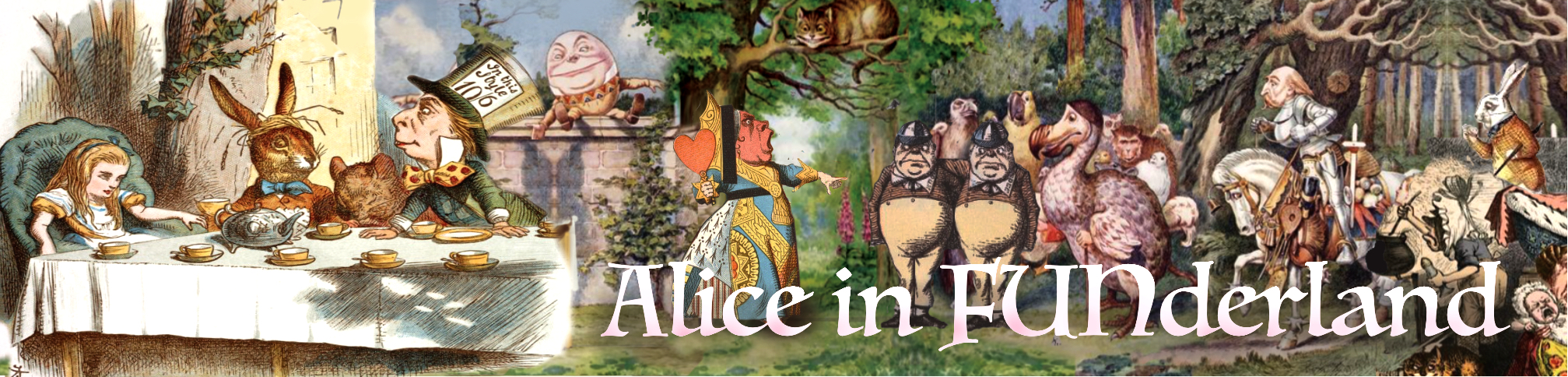
Lewis Carroll’s interest in mathematics, science, games and puzzles are on display in the books he wrote. The ideas below are based around them. Beware: they are all ‘rabbit holes’ , which could lead to a life-time’s obsession if you are not carefully monitored. Carroll’s creations are living things, morphing and mutating daily, which will keep the presenters and visitors lively at all times.
Please help it grow – feed it with ideas!
Richard Robinson Richard@BrightonScience.com – 07974 572 990
Alice in FUNderland
Lewis Carroll and PARLOUR GAMES
Back in the days before TV and computer games, there were simple games, with simple bits of paper and pencils. Lewis Carroll invented some of them. Here we play some from all around that era: Boxes: Battleships: Twenty Questions: Charades: Good news/Bad news: Squiggles: Charades… You’ll know some of them, you’ll be glad to find others.
The King of Hearts and TELLING THE STORY
The Trial scene at the end of Alice in Wonderland contains the most wonderfully confused speech, as the White Rabbit tries to explain the simplest thing to the jury, but makes less sense than Jabberwocky. And actually, children, people in general, and scientists in particular, often have difficulty explaining simple things. (Children sometimes don’t know how to start; scientists often don’t know when to stop!)
The King of Heart’s advice was “begin at the beginning, go on till you come to the end, then stop”. Many of the popular parlour games, which kept families entertained before the invention of ‘The Screen’, had elements of drama and story-telling in them. We will build stories using Story Cards, word-at-a-time games like “Good News – Bad News“, Picture Consequences, and our imaginations, to take our storytelling to new places: Our tales may not be perfect; they may not have an end, they may get lost in the middle, but the main thing is, they’ll be fun.
Our language is daft (think about ‘though’, ‘through’, ‘thought’, ‘although‘, ‘thorough’, etc, in which ‘ough’ looks the same but sounds different). It is highly ‘redundant’ too: that is, there are a lot of spare letters in every word. This is good! It means words can be recognised even if they are badly written, or in the dark, or misspelt. We have games to play with this.
For instance, sentences actually don’t even need vowels . We will play the game of NVWLS {‘No Vowels’}.
Can you work this out? Bet you can, SRPRSNGLYQCKLY
…though in such a case, one letter of place can be fatal…
…and that’s why badly written email addresses are a problem: sometimes their writing is too scrawly.
[Handy hint: get them to leave their phone number as well]
… and that’s also why Michelangelo’s Moses has horns (we will tell the strange story)
Jabberwocky and NONSENSE
Can you make sense of Jabberwocky? Clearly we can! Everybody understands what happens in it. It turns out there can be quite a lot of sense in nonsense! Contrariwise, many attempts by scientists to explain simple scientific facts end up sounding like nonsense! Let’s talk sensibly about nonsense!
The White Queen and SIX IMPOSSIBLE THINGS BEFORE BREAKFAST
Quite literally, a demonstration of 6 genuine, curriculum based, phenomenal, impossible things which occur while you are still innocently eating your cereal. Everything behaves very badly (For instance, milk sometimes pours sideways instead of down) but it isn’t nonsense – there’s a simple explanation for it all
Humpty Dumpty and RIDDLES
Humpty Dumpty IS a riddle (the answer to his nursery rhyme is: ‘it’s an egg’). Visitors sort through a variety of Victorian riddles, trying to match them with their answers. Puntastic is a game to find Christmas Cracker jokes (‘What do you get if you cross a hen with a bedside clock? An alarm cluck!’ etc). Yes, it’s a feast of Dad-Jokes
The Duchess and PARADOX
The Duchess’s famous motto :
“Speak roughly to your little child, and beat him when he sneezes. He only does it to annoy, because he knows it teases”… is an example of paradoxical behaviour – the notion that the best way to stop a child crying is to whack them! There are many more in the Paradox Papers..
The Caterpillar and LOOKING GLASS SCIENCE
The Shrinking Box can make you tiny.
A mirror shrinks you to exactly half size, no matter how far away you are. … and makes you left-handed. The lens in your eye turns you upside-down and inside out (but are you still left-handed?) Size constancy is a weird thing (Remember “This cow is small, those are far away”?) … We will show you the illusions of every-day life, and how to shrink the children small enough to fit in a box. (Real box provided)
Upside-down goggles challenge you to draw umop-episdn (that’s ‘upside-down’ typed upside down).
The Red Queen and TIME
We have an excellent internal clock, but we seldom use it. Time perception is dodgy
Murphy’s Laws of time (eg ‘How long is a minute? That depends which side of the toilet door you are on’)
Change blindness: We cannot see fast things (prestidigitation here), and we don’t notice slow things (Climate Change here).
Past and present mix up – present experiences affect your memories
Also, present experiences affect your memories.
Déjà vu, anyone?
Can time go backwards? (I have invented a time reversing machine)
The White Knight and MINDFUL MAGIC
These are simple science-based magic tricks that kids (or parents) can learn, plus an explanation of the science behind them which roots the ‘magic’ in the real world.
So…
Have a taste of Victorian fun, with the benefit of modern science. It’s all thoroughly wholesome, relaxing and captivating. Even the Red Queen may want to stop running for a moment, to have a go!
/