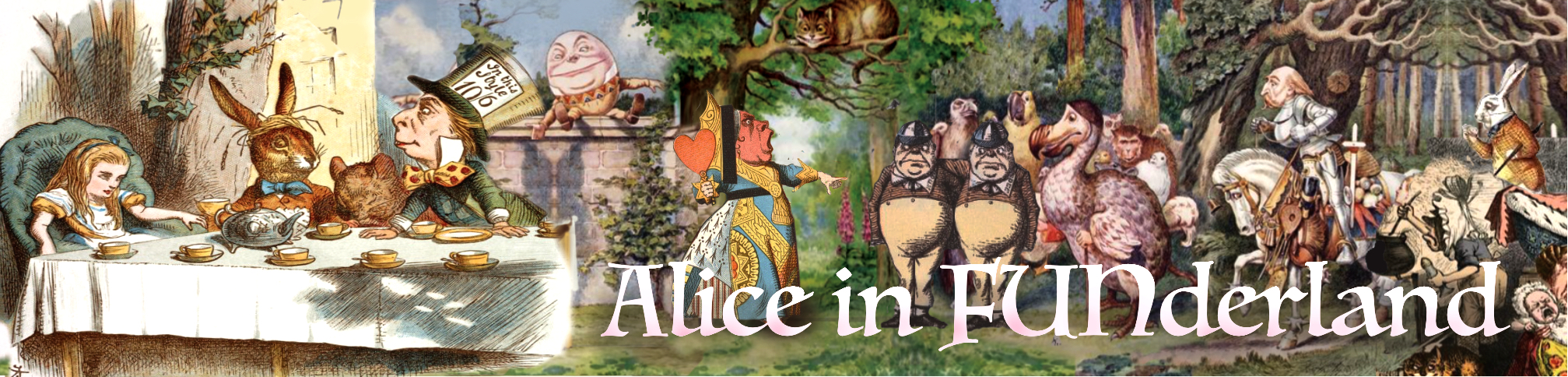
Lewis Carroll’s interest in mathematics, science, games and puzzles are on display in the books he wrote. The ideas below are based around them. Beware: they are all ‘rabbit holes’ , which could lead to a life-time’s obsession if you are not carefully monitored. In our party we will be playing parlour games, and doing simple magic, based on Alice’s adventures in Wonderland and through the looking glass. Can you really shrink? or grow? or can time speed up? or slow down? You’ll find the answer is “Yes!”
We’ll be in the suitably elegant surroundings of Preston Manor, Preston Park, in Central Brighton, Preston Drove, BN1 6SD
on Thursday October 29th , from 10,00 am till 5.00 pm – (last entry 4 pm). The party is free with admission to the Manor.
Tickets HERE
Alice in FUNderland
Lewis Carroll and PARLOUR GAMES
Back in the days before TV and computer games, there were simple games, with simple bits of paper and pencils. Lewis Carroll invented some of them. Here we play some from all around that era: Boxes: Battleships: Twenty Questions: Charades: Good news/Bad news: Squiggles: Charades… You’ll know some of them, you’ll be glad to find others.
Parlour games reflect the different themes. They’ll pop up all round the Manor.
Humpty Dumpty and RIDDLES
Humpty Dumpty IS a riddle (the answer to his nursery rhyme is: ‘it’s an egg’). Visitors sort through a variety of Victorian riddles, trying to match them with their answers.
The Duchess and PARADOX
The Duchess’s famous motto :
“Speak roughly to your little child, and beat him when he sneezes. He only does it to annoy, because he knows it teases”… is an example of paradoxical behaviour – the notion that the best way to stop a child crying is to whack them! There are many more in the Paradox Papers..
The Caterpillar and LOOKING GLASS SCIENCE
Alice grew and shrank several times – so do you, all the time!
A phone camera shrinks you tiny when you move away; a mirror shrinks you to exactly half size, no matter how far away you are. … and makes you left-handed. The lens in your eye turns you upside-down and inside out (but are you still left-handed?)
Size constancy is a weird thing (Remember “This cow is small, those are far away”?) … We will show you the illusions of every-day life…
…and how to shrink the children small enough to fit in a box. (Real box provided).
The Red Queen and TIME
We have an excellent internal clock, but we seldom use it. Time perception is dodgy
Murphy’s Laws of time (eg ‘How long is a minute? That depends which side of the toilet door you are on’)
Change blindness: We cannot see fast things (magic tricks here), and we don’t notice slow things (Climate Change here).
Past times and present times can get mixed up – present experiences affect your memories
Also, present experiences affect your memories.
Déjà vu, anyone?
The White Knight and ASSUMPTIONS
Here are simple science-based magic tricks that kids (or parents) can learn, plus an explanation of the science behind them which roots the ‘magic’ in the real world.
The White Queen and SIX IMPOSSIBLE THINGS BEFORE BREAKFAST
Quite literally, a demonstration of 6 genuine, curriculum based, phenomenal, impossible things which occur while you are still innocently eating your cereal. Everything behaves very badly (For instance, milk sometimes pours sideways instead of down) but it isn’t nonsense – there’s a simple explanation for it all
So…
Have a taste of Victorian fun, with the benefit of modern science. It’s all thoroughly wholesome, relaxing and captivating. Even the Red Queen may want to stop running for a moment, to have a go!
We’ll satisfy your curiosity, and leave you curiouser!
/